Every Culture Discovered Patchwork. Only One Never Forgot It.


Before it was a trend, it was a truth.
Every piece of patchwork carries two stories at once. The story of the cloth it is made from, and the story of the hands that refused to let it go to waste. And what makes this genuinely remarkable is that those two stories repeat themselves across thousands of years and dozens of civilisations, none of which knew the others existed.
Patchwork was not invented by one culture and borrowed by the rest. It was DISCOVERED. Independently. Repeatedly. By every society that ever understood that fabric is not a disposable thing.
That is not a trend. That is a human constant.
And if you trace that constant honestly, without the distortions of Western fashion history, one thing becomes very clear very quickly. India was not a footnote in this story. India was the CHAPTER.
So let us go all the way back to where it starts.
The Oldest Surviving Patchwork: Egypt, 980 BCE

The earliest confirmed patchwork artifact in the world comes from Egypt, a civilization that sat at the extraordinary crossroads of northeastern Africa, the Middle East, and the Mediterranean world.
It is a funeral canopy, dated to approximately 980 BCE. Made from pieces of dyed gazelle hide, stitched together in a deliberate and structured pattern.
Not scraps. Not emergency repair. A designed object, created specifically to accompany the dead into the afterlife.
Nearly three thousand years ago, someone in ancient Egypt looked at pieced together cloth and decided it was worthy of the sacred. That is the first entry in the historical record of patchwork, and already it is telling us something profound.
The practice was almost certainly even older than this single surviving object. Any civilisation that wove cloth and wore it would also repair it. The canopy is simply the earliest example we have not lost to time.
The Islamic World and the Silk Road: 10th to 14th Century
Between the 10th and 14th centuries, patchwork spread and deepened across the Islamic world. Persia and Turkey in western Asia. Egypt in northeastern Africa. The Central Asian trade corridors stretching between the Caspian Sea and the western edge of China. One enormous, connected network of craft, knowledge, and exchange.

The oldest surviving quilt in Europe came directly from this world. A Sicilian quilt, dated to approximately 1360 to 1400 CE. It depicts scenes from the legend of Tristan and Isolde, and it almost certainly came from a North African or Islamic workshop. Sicily sits at the southern tip of Europe, directly across the Mediterranean from North Africa. That geographic pinch point is exactly where two civilisations would exchange ideas. And the piecing technique in that quilt is far too sophisticated for European craft of that period. Someone who KNEW what they were doing made this.
But the detail that stays with you, once you encounter it, belongs to the Sufi dervishes of Central Asia.
These wandering mystics of the Islamic tradition wore patchwork robes called a “KHIRQA”. And each patch was not random. Each one represented a teaching received from a different spiritual master. The robe was a MAP. A wearable, visible record of everywhere a person had studied and everyone who had shaped them.
Cloth as biography. Patchwork as autobiography.
Central Asian rulers also gifted patchwork robes as marks of distinction. In this world, assembled cloth did not signal poverty. It signalled MEANING.
Japan and Korea: When Patchwork Became Art
If the Islamic tradition elevated patchwork into philosophy, Japan, an island nation off the eastern coast of Asia, turned it into something that belongs in a museum. Which, eventually, it did.
The tradition is called BORO. From the word boroboro, meaning tattered or threadbare. In the farming and fishing communities of northern Japan, cotton was scarce and winters were brutal. Families stitched together every fragment of indigo-dyed cloth they owned, layering and repairing over generations. A single jacket could carry the physical repairs of three or four generations of the same family. The dense running stitch used to hold those layers together, known as Sashiko, became its own art form in the process.
For centuries, boro was treated as an object of shame. Poverty made visible.

Then, in the 1980s and 90s, collectors and museum curators looked again. What they found were documents of extraordinary depth and beauty. Objects that contained, literally in their fibres, the record of generations of survival, daily life, and care. Today, antique boro pieces command tens of thousands of dollars at auction.
It turns out, we simply had not been paying proper attention.
Korea, on a peninsula on the northeastern edge of the Asian continent directly west of Japan, has its own answer to boro. They call it Pojagi. Wrapping cloths assembled from geometric scraps of silk, hemp, or cotton, pieced together with such precision that they resemble stained glass. The finest pojagi, made from silk offcuts left over from royal court tailoring, are immediately, visibly, breathtakingly beautiful.
The material was leftover. The result was anything but.
Colonial America: Patchwork as Community
The American quilting tradition is the most familiar chapter in patchwork history for most readers. And yet it is consistently underestimated for what it actually represented.
America, in its colonial and early national period, received its quilting tradition from European settlers who carried fabric-saving habits across the Atlantic. Imported cloth was expensive. Heavily taxed. Often unavailable. Every household recycled every scrap. Women developed the quilt as an object that was functional and social and commemorative and communicative all at once.
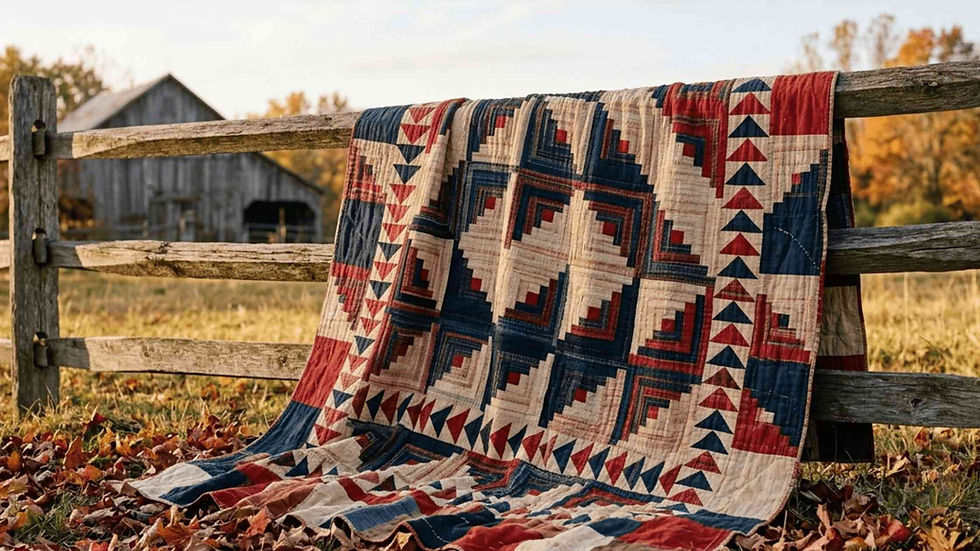
The quilting bee was the centre of this world. Women gathered, in one of the only formal social spaces available to them outside the church, to piece and stitch together and exchange patterns and skills and stories. These gatherings were not incidental to the textile tradition. They WERE the textile tradition.
The patterns that emerged, Log Cabin, Flying Geese, Double Wedding Ring, Bear Paw, were named, codified, and traded between households across generations like family recipes.
And during the Civil War era, certain patterns are believed to have been stitched onto quilts hung outside homes as signals along the Underground Railroad, guiding escaped enslaved people toward freedom. Whether the full extent of this practice is confirmed by historians or not, the cultural truth it contains is real.
By the 19th century, patchwork in America had become a LANGUAGE.
A remarkable tradition, without question. But it was roughly two thousand years younger than what was already happening in India.
India: Where Patchwork Was Never Not Happening
Let us be very direct about something.
Patchwork did not arrive in India. It did not travel here from the Americas or Europe or Japan. It was already here, in multiple forms, across multiple regions, woven into daily life and royal culture alike, centuries before the Western world had developed any comparable tradition.
India was not catching up to anyone. It never needed to.
And as an Indian, that is not a point of pride I state quietly. That is something our industry, our craftspeople, and our country DESERVE to have said plainly and loudly in every conversation about global textile history.
India occupies the great southern peninsula of Asia, from the Himalayan mountains in the north to the Indian Ocean in the south, the Arabian Sea to its west and the Bay of Bengal to its east. Its position at the intersection of Central Asian, Middle Eastern, and Southeast Asian trade routes made it one of the defining textile civilisations of the ancient world. While Europe was still learning to piece cloth, India had already developed six distinct, sophisticated, regionally unique patchwork traditions. Each with its own philosophy. Each with its own visual language. Each ALIVE today.

Kantha, Bengal and Odisha.
In the eastern part of the subcontinent, bordering the Bay of Bengal, women took old saris and layered them together, stitching through all the layers with thread pulled from the borders of the very same worn cloth. Each kantha is a biography of a family's worn life, compressed into something new. This tradition alone, in its intimacy and ingenuity, is worth more scholarly attention than a hundred Western quilt pattern books.
Ralli, Sindh and the Rajasthan Border.
Across the Thar Desert, the arid expanse of northwestern India stretching west into present-day Pakistan, women made ralli quilts that are among the most visually commanding textiles in all of South Asia. Bold. Geometric. Symmetrical. Intensely coloured. Made from every fragment of cloth available and given at every threshold of life. These quilts predate the American quilting tradition by centuries. Nobody in the West is teaching that in their design schools.
Gudri, Jaipur, Rajasthan.
And then there is home.
In Jaipur, in the northwestern state of Rajasthan, patchwork was not the practice of the poor. It was the practice of the PALACE. When a maharaja's robes wore out, the cloth was not discarded. It was cut and layered into quilts of extraordinary richness, compressed histories of royal dress, heavy with silk brocade and printed cotton from the court. To sleep under a gudri was to sleep under centuries of Rajput textile culture.
This is Jaipur's gift to the world of sustainable fashion. Not borrowed from anywhere. Not inspired by anything foreign. Entirely, unapologetically, magnificently our own. The tradition continues in workshops around the old city today, carried forward by the same hands and the same knowledge that have always held it.
Sujani, Bihar.
In the northern-central plains of the subcontinent, groups of women stitched shared stories into sujani quilts, narrating community history and mythology through layered recycled fabric and embroidery. The quilt as the recorded oral history of an entire village. A tradition of such cultural depth that it deserves a documentary, not just a footnote.
Phulkari, Punjab.
The fertile plains of northwestern India and eastern Pakistan give us phulkari, celebrated for its embroidery but built on a pieced base cloth the embroidery then conceals. The labour of repair, hidden under the labour of beauty. Punjab has always known how to carry its strength quietly.
Katab, Gujarat.
On the westernmost edge of India facing the Arabian Sea, katab is appliqué patchwork at its most technically demanding. Cut-cloth motifs of great intricacy, layered onto a base fabric and combined with mirror work and embroidery, used in ceremonial hangings and wedding textiles. Gujarat's craft culture has never needed validation from anywhere outside its borders.
Six distinct traditions. One country. All of them ONGOING.
India has never apologised for its volume. It has never believed that elegance requires silence or that restraint is the highest form of sophistication. From the colour-drenched streets of Jaipur to the intricate Kantha stitching of Bengal, this country has always understood that fabric is precious, that beauty can be made from what others consider finished, and that nothing worth keeping ever gets thrown away.
That is not a lesson India learned from the world.
That is a lesson India has been TEACHING the world for three thousand years.
The 1960s and 70s: Counterculture Makes It Fashion
The moment patchwork became a global fashion statement can be located with some precision. And the speed of what followed is instructive.
The American and European counterculture movements of the late 1960s adopted repaired, recycled, and handmade clothing as a political uniform. Western Europe, the industrialised nations at the western edge of the Eurasian continent, and America moved in cultural lockstep, sharing music, protest politics, and a common visual language across the Atlantic. Young people chose patchwork deliberately. It looked like refusal. It looked like making do. That was entirely the point.
Janis Joplin performed in it. Cher wore it on television. Woodstock fixed the image globally.
And then, within a decade, something entirely predictable happened. Fashion absorbed it. Valentino in Italy, Yves Saint Laurent in France, and Missoni across the European fashion capitals produced patchwork-influenced collections. Couture had claimed what the protest movement had invented.
What nobody said loudly enough at the time, and what we should say now, is this.
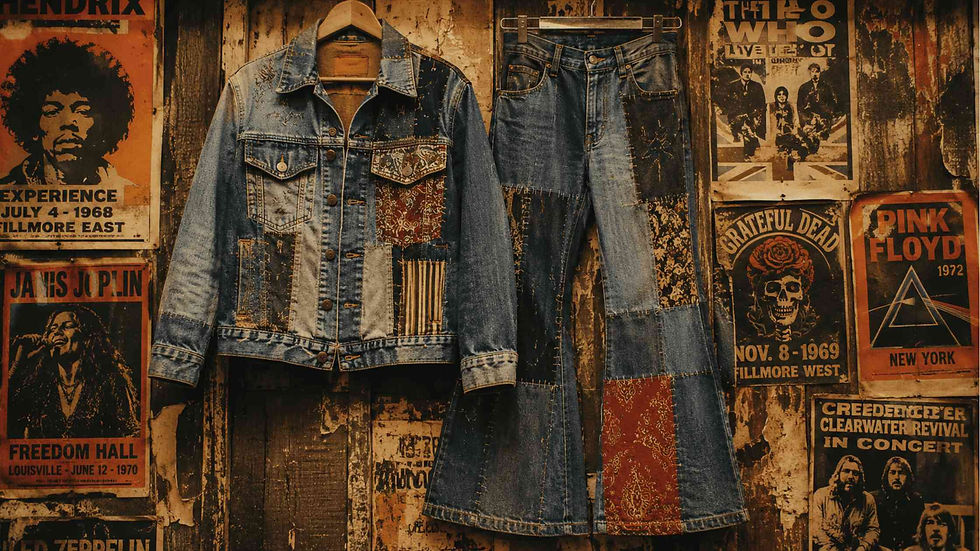
The knowledge those designers were drawing from, the layered textiles, the pieced fabrics, the philosophy of assembled cloth, had been alive and practiced and PERFECTED in India for centuries before a single Western designer put it on a runway.
A textile tradition stretching back three thousand years, kept alive continuously on this subcontinent, became a TREND in the West in about seven years. They called it new. They called it radical. They called it revolutionary.
We called it Tuesday.
The Full Circle: Why Patchwork Is the Future of Fashion and Why India Leads It
The fashion industry is now being held accountable, in a way it never has been before, for what it produces and what it wastes. Fast fashion has created a system where garments are discarded after a handful of wears. Global textile production generates waste at a scale that is genuinely difficult to comprehend.
And into this reckoning, patchwork has returned.
Not as nostalgia. Not merely as a trend. As the most honest and credible sustainable practice the industry has available to it.
Because patchwork does not just CLAIM sustainability. It demonstrates it. Every seam is evidence. Every stitched panel is a piece of cloth that did not go to landfill. Loewe, Marni, and Dries Van Noten have all made upcycled patchwork construction a recurring collection theme. Every major fashion week since 2018 has featured it. Demand for upcycled patchwork fabric wholesale has surged across Europe and the United States as buyers look for product they can genuinely stand behind.
And where are those buyers looking?
They are looking at India.
They are looking at Jaipur.
As they should.

For Rajasthan, this moment is not a discovery. It is a recognition that is long, long overdue. The gudri tradition, the block-printing culture, the craft density of Jaipur's old city workshops, and the volume of post-industrial textile offcuts generated by the city's own garment industry have all been sitting here together, ready, for centuries.
The global market has not found something new. It has finally caught up to something ANCIENT. Something Indian. Something that was never lost because the people who held this knowledge never let it go, even when the world was not watching, even when it was not fashionable, even when nobody was paying the price it deserved.
Indian craftspeople kept this alive. Indian hands kept this knowledge. Indian workshops carried this forward. And now the world wants it.
Good. It was always ours to give.
What patchwork has always been, across Egypt and Central Asia, across Bengal and Bihar, across Appalachia and Osaka, is a refusal to waste what took effort to make. Today, we call that refusal sustainability. We give it certifications and carbon calculations and marketing language.
But the stitch is three thousand years old.
And in India, it never stopped.
Anamica Fashion is a Jaipur-based B2B wholesale manufacturer specialising in upcycled patchwork fabric, boho apparel, and home decor produced from post-industrial textile waste. With over 20 years of production experience, we supply buyers across Europe, the USA, and global markets. Explore our wholesale range at anamicafashion.com.

$50
Product Title
Product Details goes here with the simple product description and more information can be seen by clicking the see more button. Product Details goes here with the simple product description and more information can be seen by clicking the see more button

$50
Product Title
Product Details goes here with the simple product description and more information can be seen by clicking the see more button. Product Details goes here with the simple product description and more information can be seen by clicking the see more button.
$50
Product Title
Product Details goes here with the simple product description and more information can be seen by clicking the see more button. Product Details goes here with the simple product description and more information can be seen by clicking the see more button.

Comments